
|
|
 |
|
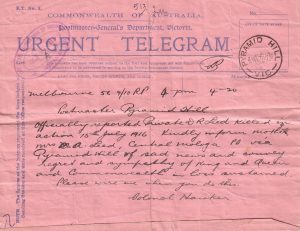
The Pink TelegramPreface
To Postmaster (ADDRESS) Officially reported (RANK & NAME) killed in action (DATE). Kindly inform (NEXT OF KIN, E.G. MOTHER + NAME & ADDRESS) of sad news and convey regret and sympathy of King and Queen and Commonwealth in loss sustained.
+++ Chapter One Home Sweet Home Gundagai NSW, June 28, 1914.  Flo Marshall with Dr Gabriel’s cockatoo +++ It was a glorious day for all creatures great and small… With most stops out, Edith Putland was pumping stoically away at the organ in St David’s Presbyterian Church. Reverend MacPherson led the congregation in belting out the first hymn, full of faith and forgiveness for Edith if she hit the occasional bum note. She was a treasure, and a handsome one at that. “Glory be to God the Father Glory be to God the Son Glory be to God the Spirit Great Jehovah, three in one!” The Hayman clan took up two pews this fine Sunday. Eighty-year-old matriarch, Sarah, sat nearest the wall, across from the stained glass window dedicated to her son, William. Next to her was William’s widow, Amy, whose surviving six children had all joined the throng. There was her only daughter, teacher and hopeful spinster, Laura, who sat next to the youngest, Kenneth. Kenneth was sixteen going on seventeen and sick of being called ‘the boy’. After all, he had a real job now, at the Post Office, delivering mail by bicycle. In his room at the Royal Hotel in Sheridan Street, hungover postmaster Dallas Bryson dragged himself out of bed, gave his ample gut a stained-singlet scratch and took a pee in the hand-basin. Far too hard and fuddled to make it to the communal bathroom… and it saved the chore of rinsing the chamber pot that may, or may not, have been lurking in the creaking shadows. A fart, a burp and a groan later, he sat on the bed and rolled the first cigarette of the day. He had no recollection of making it up the stairs but it had to be late. He felt like crap. Mr Bryson was what church-going folk of the day would refer to, in private of course, as a ‘lushington’ but he was far from the minds of this St David’s gathering. A few of those minds heeded the scriptures but most were a meditative mile away, pondering nothing in particular or things needed to be done. In the second pew were Laura’s and Kenneth’s brothers, Harold, Wattie, Billy and Cleave. It was rare to see Wattie in attendance. Perhaps he needed to return to his mother’s good books following an outburst of profanity or some broken crockery. Wattie still lived at home despite being christened in this very church some 28 years ago. Amy was the only person who still called Wattie by the name he was given, Walter. Billy’s wife, Emily-Jane, sat with her hands resting patiently and lovingly above their unborn child. The eighteen months since they had wed at St David’s had flown by. Cleave and Florence had made the effort to travel in from the farm at Darbalara. Their little one, Laureen, sat between them, kicking her little legs and sucking on a milk arrowroot biscuit. All in all, the family liked to appear functional to the outside world, preferring to keep any emotional baggage neatly stowed. Reverend MacPherson gave thanks for the finding of two little members of the flock who were not well enough to attend this day’s Sunday School or following service. Nancy Cole, aged 8, and her brother Frank, aged 5, had strayed from their home near Kimo and had somehow survived nine days without food. They were badly bruised and suffering from hyperthermia and dehydration but were expected to make a full recovery. “The Lord works in mysterious ways…” If anyone’s particular religious persuasion lent itself to belief in The Lord there could be no argument regarding His ways. In less than six hours, in a far off place called Sarajevo, an idealistic terrorist by the name of Gavrilo Princip would assassinate an Austrian by the name of Archduke Franz Ferdinand. And that event would be the precursor to the deadliest conflict in human history. The Lord works in mysterious ways indeed.  Archduke Ferdinand in Sarajevo. Insert: Gavrilo Princip +++ Franz Ferdinand and his wife, Sophie, were celebrating their wedding anniversary and being chauffeured through the streets of Sarajevo in an open-topped automobile. The car stalled outside Moritz Schiller’s café and Princip pounced with pistol drawn. He fired twice at close range. One bullet ripped through Franz Ferdinand’s neck, the other exploded into Sophie’s abdomen as she reached across to protect her dying husband. This assassination would lead to more than 17 million deaths and 20 million wounded in the four and a bit years that followed. There would be more than 200,000 Australian casualties including over 60,000 killed. No Australian family would be untouched. The next of kin of those killed in action were informed by military correspondence known as ‘The Pink Telegram’. Pink Telegrams would be soon be sent to several of the mothers and wives whose minds were a meditative mile away. Dallas Bryson would receive those telegrams and Kenneth Hayman would deliver many of them. The lives of this congregation, like other communities across this wide brown land, would be torn asunder. “The Lord works in mysterious ways…” +++ While other Bosnian-Serb idealists of the day saw Gavrilo Princip as a martyr to their cause – to unify Yugoslavia and end Austro-Hungarian rule – he was a tosser and a thug. Sort of Ned Kelly without the charisma, sense of humour or sense of the way the world worked. In fact, he was stupid, and somewhat of a failure. After killing Ferdinand and Sophie he took a cyanide pill, attempting suicide. The pill, however, was well past its use-by-date and potency so he snapped into Plan B. He tried to shoot himself but the still-loaded pistol was wrestled from him before he could pull the trigger. There is a saying that a punishment should fit the crime, so one would think execution the appropriate penalty for Princip. Not so. Under Hapsburg law, a person had to be at least 20 years old to be given the death penalty. Young Gavrilo was 27 days shy of that birthday and, as such, was sentenced to 20 years imprisonment. A lucky break for him? No, not really… Conditions in the political prison camp, Terezin, were harsh and made even harsher by the war. Princip only served three years and ten months of his sentence because he contracted skeletal tuberculosis. The disease ate away at his bones with one arm having to be amputated and he died weak, malnourished and in pain, weighing just 40 kilograms. Karma works in mysterious ways. Rather than unite Yugoslavia, Gavrilo Princep’s actions divided the world following a very simple and predictable domino effect. Austria and Hungary blamed Serbia for the assassination/attack. Russia was a backer of Serbia and France was an ally of Russia. Kaiser Wilhelm decided to throw Germany’s weight behind Austria and Hungary and, when Britain threw its hat into the ring against Germany, the colonies of Australia and New Zealand were also at war. Troops on both sides thought they were the goodies and the other side were the baddies and that it would all be over before you could say “pass me that white flag.” Sarah Hayman would see one son and fifteen grandsons enlist and travel halfway around the world to fight in that war. Three of the boys would not return, paying the ultimate sacrifice on the battlefields of France and Belgium… and the other lads would return with physical and/or emotional injuries. One lost a leg, one lost an arm, one lost full use of his lungs and several, every now and then, lost their marbles. +++ Gundagai NSW, July 26, 1914.  Gundagai station – all curious as to the man with the camera +++ While the world had moved on in leaps and bounds, the town of Gundagai was still treading water is a sea of contentment, even though that contentment now had an edge. In another month of Sundays this one was special. It was a celebration. Sarah Hayman was strict, loving and wise. And relatively old. It was her 81st birthday and her clan had gathered at the Church Hall to mark the occasion. There were actually three ‘clans’ because two of her daughters, Annie and ‘Dolly’, had married into the Doust family and her other daughter, also called Sarah, was now a Williams. The Williams chapter had dressed to the nines and had arrived on the late morning train, all the way from Jugiong. Along with burying her husband William, Sarah had seen three of her sons die at a far too early age but she had watched her other offspring grow into fine adults. She felt very blessed to have such a close family. The most recent addition to the fold, little Laureen, slept peacefully in Sarah’s arms. She was tired out after some excellent attempts at toddling while her mother was in the kitchen. Sarah and some of the clan had attended the morning service, as usual, others had made the Anglican and Methodist faiths their spiritual home while others had faded into paying Christmas and Easter lip service at best. No doubt Laureen would attend Sunday school when she was old enough. It was a family tradition and the gateway to an informed choice. The Reverend MacPherson, or ‘Mr Mac’ as he was fondly known, hovered in the background, mingling occasionally for small talk and a smile. He took the ginger-nut biscuit from his saucer and dunked it in his tea. White with two. He made a mental note to praise Edith Fergusson for her musical support and dedication. Postmaster, Dallas Bryson, had departed swiftly, well before the church hall began to hum. His attendance was the first in some years. Unshaven but with polished shoes and best braces he sat in the back pew, in the aisle near the door. He stood for the hymns but didn’t sing and the prayers washed over him. He was there with hope, not faith. He wanted to make himself known to Amy Hayman, Kenneth’s mother, the widow he had admired from afar for some time. Dallas knew instinctively that he was out of his league but, as Kenneth’s employer, he sensed a window of opportunity. Following the benediction he returned his hymnbook to the stack on the table in the foyer and went outside to wait for the others to make their way out. He put on his hat and straightened his collar. The Haymans emerged as a group. Dallas tipped his hat. “Kenneth…good morning to you.” Kenneth extended his hand. “Mr Bryson, sir…” They shook hands but Dallas looked to Amy for eye contact. “And, um, good morning to you, Mrs Hayman. I’m Dallas Bryson, from the…” “I know who you are Mr Bryson,” Amy replied, “You’re my son’s boss.” “Indeed I am Mrs Hayman, and may I say what an impressive young man you have raised. Polite, efficient and, um, punctual.” “Thank you, Mr Bryson.” “Yes, um… there’s a fine future in the post office for an ambitious young man.” “I’m sure there is.” “Oh yes. Did you know that the first mail to be delivered by air occurred just a couple of weeks ago.” “Carrier pigeon, Mr Bryson?” “Aeroplane, Mrs Hayman.” “No, I did not know that. Do tell.” “Oh yes. Melbourne to Sydney in less than two days. Actual flying time under ten hours. Imagine that, eh? “So the Wright brothers were right by name and nature.” “Pardon?” “Nothing.” “Yes. French chap flew the plane. Stopped at Seymour, Wangaratta, Albury, Wagga Wagga, Harden, Goulburn and Liverpool en route. Way of the future if you ask me.” “Yes, very impressive.” “Yes. Right then. I’d better be going.” “Nice to see you Mr Bryson. And I hope we see you again. Here, at church.” “Yes Ma’am.” It hadn’t gone as swimmingly as Dallas had imagined or rehearsed, but it was a start. He disappeared into the bright daylight. +++ Sarah pushed Laureen’s soft locks away from her forehead. She could only see one Catholic lad, James Maher. James, or ‘Jimmy’ as he was known, was a 23-year-old coach trimmer, a hard-working fellow and an excellent horseman who hadn’t come for the birthday festivities. He had his eye on Sarah’s granddaughter, Laura, who was also 23 and a schoolteacher. Laura had helped her mother and aunts prepare the sandwiches, cakes and scones and had left the church grounds to meet Jimmy on the street. There was no ill will towards Jimmy from anyone in Laura’s family; it was just a matter of religions respecting each other’s geography. The Hayman men were happy to give a nod of recognition hello but old habits were hard to break. The ‘left-footer Micks’ had attended a different school and God knows what went on inside their church walls. It was early days in Laura’s and Jimmy’s relationship but it was the first time a young man had made Laura’s pulse quicken and her heart skip a beat. The prospect of marriage, however, had not popped up in conversation or, indeed, had actually crossed anyone’s mind, apart from Laura’s. Mixed marriage was a division of faith rarely crossed and something not worth wasting thought-space on until it happened. Sarah and Laureen were joined by Lillian Doust who just wanted to wish her grandmother birthday wishes again before she cycled to the hospital for the afternoon shift. Dr Gabriel didn’t operate on Sundays unless there was an unavoidable emergency but he did insist on the hospital to be staffed around the clock.  Nurses at Gundagai hospital +++ Laura’s brothers, Billy, Harold, Cleave and Wattie were chatting with a couple of the young Doust men in the shade of a large eucalypt just outside the hall. The prospect of war in Europe was a looming possibility and Mr Mac had mentioned countries and their people facing conflict in his prayers. The possibility of war was actually looming larger than they imagined. In two days, on July 28, war would officially be declared by Britain and, on August 4, Australia would also be at war. This was Sarah’s day but the men’s conversation had a measured tone of hypothetical concern. Probably why they subconsciously walked their words away from inside the hall. The men under the tree were joined by Kenneth, the youngest Hayman boy. He was a strapping lad – tall enough to mix it with the men but without the life experience to actually cut the mustard. A man in short pants if you like, but far too manly to be inside with the women. “If war is declared,” said Billy, “I can’t see it lasting long. And can’t see why it should involve Australia.” Cleave was rolling a cigarette. “If Britain goes in, we go in… like in the Boer War. We’re part of the Commonwealth.” “What was the bloody point of Federation?” said Billy, neither expecting or getting a response. “If Australia goes to war,” said Wattie, “Do you think it would be voluntary enlistment or conscription?” “Be voluntary first I reckon,” replied Harold, “They would need to hold a referendum to get conscription happening. I’d probably sign up.” “Me too,” said Frederick Doust. Kenneth nodded. “Me too.” “You’re too young,” said Billy, dismissing him from the conversation with a glance. A verbal clip around the ears, if you like. “And I certainly wouldn’t be rushing into it.” Billy had good reason to think of his own situation at home. He was now thirty and settled. He married local girl, Emily Davidson, in 1912 and they had a baby on the way. He had also been promoted to a managerial position at the butter factory and the future looked solid. Cleave was in a similar situation. He had Florence to think of, and their little Laureen, and he had invested in his own butcher’s shop to supplement income from the farm. From the paddock to the plate. He would, however, sell the shop and enlist in April 1916, following the birth of Laureen’s brother, Patrick. “Not much keeping me here,” contributed Wattie. Wattie was no spring chicken but hadn’t ‘settled’. He probably never would. His menial job at the flour mill didn’t offer much in the way of promotion and there was no special partner in his life. He enjoyed a laugh, he enjoyed a drink and didn’t stress too much. Wattie would enlist, but not until March the following year when it looked as though the war would be a long haul. Olaf Doust remained silent but he was thinking. He was a woolclasser and he figured he would at least stay put for the September spring shearing. He would be 19 when he enlisted on October 8 and embark for Egypt ten days later from Sydney on the HMAT Afric. Harold Hayman’s remark that he would ‘probably sign up’ came somewhat as a surprise to his brothers. Harold was the quiet, steady one and mature beyond his 21 years. He had studied hard and had embarked on a career as a schoolteacher. But, as they say, “it is sometimes the quiet ones…” Harold was single, fit and hadn’t actually given his career a thought before speaking. He had recalled his days as a cadet and the two years he took out the local rifle shooting competition. He also had an ingrained sense of duty and would, in fact, enlist in a matter of weeks. Because of his cadet training he would be given the non-commissioned officer rank of Sergeant and embark for training in Egypt on the HMAT Suffolk on October 18. Frederick Doust would also sign up quickly, on September 18. Frederick was a shop assistant and was keen for travel and adventure. After training in Victoria he would embark for Egypt as a Private on December 22, on HMAT Ulysses, under the command of John Monash. Like Harold, Frederick was just 21. For Harold, Olaf and Frederick it would be their first Christmas away from family. Laura squeezed Jimmy’s hand, bid him farewell with a hastily stolen soft kiss on the cheek and returned to the church hall. She blushed a little as she passed the men and headed for the kitchen. The men watched Jimmy mount his horse and admired how effortlessly he took it from a walk to a canter. He certainly had a way with horses. Lillian stopped on her way out for a brief catch up with the men. “What are you fellas chatting about?” “Nothing,” said her brother, Frederick. “Looks like there could be a war,” said Kenneth. “Not that it should concern you, Lil,” said Harold. “Ahh, but it might you know. Dr Gabriel says that there would be a role for nurses to play. It might be a conversation worth avoiding, but war doesn’t come without casualties.” “War’s not a place for women,” offered Billy. “Or boys…” “We’ll see. Gotta get going.” Doctor Charles Louis Gabriel was an excellent doctor, surgeon and a wise sounding board for advice on most situations. He had also embraced photography with both passion and talent. He had captured many of the happenings and people in the town for over a decade including Masonic funerals, floods, political visits, visiting circuses, sporting matches, the hospital and staff, family, friends, folks coming and going and people with pets. Sometimes people with his own menagerie – his dog, his two cats, his cockatoo and his prized pet monkey.  Dr Gabriel’s matron with Dr Gabriel’s monkey +++ |